


By Max Fellows, Founder of allpoints
Introduction – Where does the events industry go next?
This month, we’re looking beyond what is happening in the events and brand experience industry today and asking what comes next.
We put a series of questions directly to our network of CMOs, Heads of Events and Brand Leaders, asking them where they see the biggest opportunities for growth, what they believe could hold the industry back and where agencies should be investing their time and energy.
These are original insights collected directly from the people responsible for commissioning, shaping and measuring brand experiences. Together, they provide a snapshot of an industry that remains confident in the value of live experiences, but is becoming increasingly focused on commercial relevance, integration and measurable impact.
For agency leaders, staying close to these shifts matters. What clients expect from their partners is evolving, and the strongest opportunities increasingly sit beyond simply delivering the brief.
Key findings
- 57% want agencies to get closer to their clients’ commercial objectives, not just their creative briefs
- 59% see the convergence of events, content, digital and wider marketing as the greatest opportunity for industry growth.
- 67% describe the industry as healthy, but operating with significant uncertainty.
- 89% see economic pressure and reduced marketing budgets as the biggest threat over the next 24 months.
1. Growth will come from greater integration
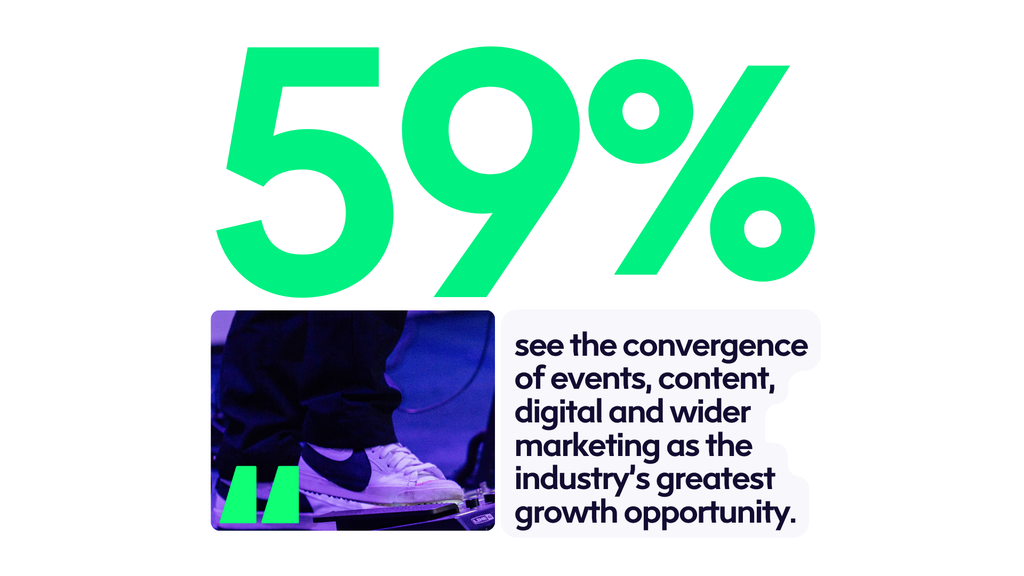
Brand leaders are pointing towards a more connected future for events. 59% selected the convergence of events, content, digital and wider marketing strategies as the strongest opportunity for growth, compared with 24% who prioritised community-led, year-round engagement. Technology-led opportunities ranked lower, with 12% selecting AI-powered personalisation and 6% immersive or XR-enhanced experiences, while international expansion received 0%.
The opportunity therefore appears to be less about introducing technology for its own sake and more about making experiences work harder across the wider marketing ecosystem. For agencies, this means thinking beyond the event itself: how an experience feeds content, digital channels, community, CRM and long-term brand activity could increasingly become part of the value they are expected to bring.
2. The industry feels healthy, but uncertainty remains
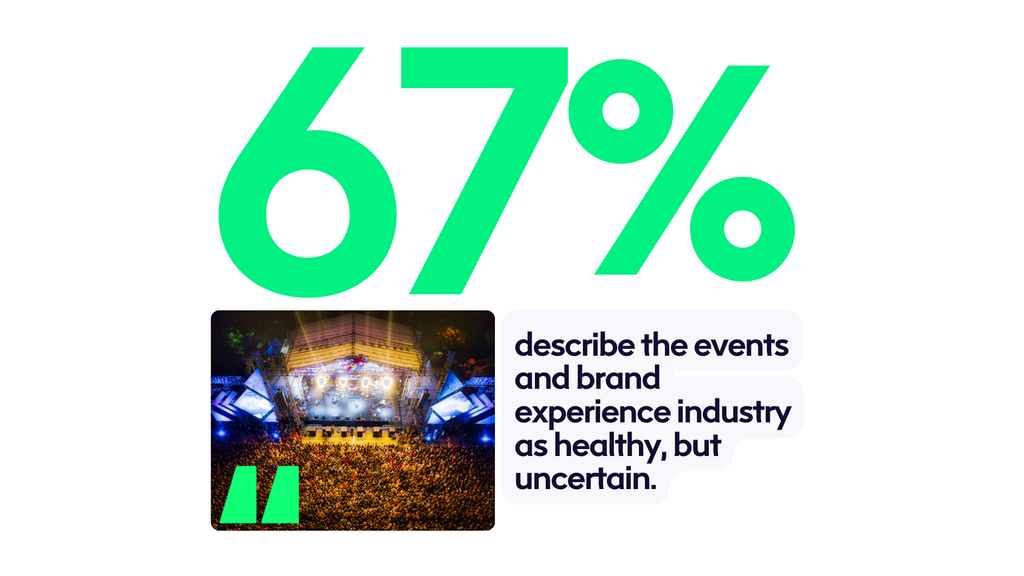
The overall picture is positive, although confidence comes with caveats. 67% described the industry as healthy but uncertain, recognising strong underlying demand alongside significant headwinds. A further 33% believe the industry is actively thriving, with strong demand, innovation and growing investment.
Notably, 0% described the sector as being fundamentally under pressure or in need of reinvention. That suggests brand leaders still see a strong role for events and experiences. The challenge is maintaining that value in a more commercially cautious environment. Agencies that combine creativity with financial awareness, adaptability and a clearer understanding of business priorities will be better equipped to navigate that uncertainty.
3. Economic pressure is the industry’s biggest threat

Financial pressure dominates the risk landscape. 89% selected economic pressure reducing marketing budgets and the share of spend allocated to events as the industry’s biggest threat. By comparison, 7% pointed to talent shortages and 4% to the industry’s ability to innovate quickly enough. 0% believe AI reducing the need for human connection is the primary threat.
The message is significant. The greatest perceived risk to live experiences is not technology replacing them, but whether they can continue to justify investment when budgets come under pressure. That puts greater emphasis on demonstrating commercial value, setting meaningful measures of success and giving internal brand teams the evidence they need to defend event spend within the wider marketing budget.
4. Brand leaders want agencies closer to commercial objectives

When asked where agencies should focus their energy and investment, 57% prioritised getting much closer to clients’ commercial objectives rather than simply their creative briefs. A further 21% want agencies to build a genuinely differentiated measurement and ROI proposition, while 14% prioritised credible, demonstrated AI and technology capability. 7% want agencies to explore supplementary services such as content creation, while sustainability credentials received 0% of selections as an immediate priority in this poll.
Taken together, the findings point towards a shift in what defines a valuable agency partner. Creative capability remains important, but brands increasingly want partners who understand why the activity exists in the first place. Agencies that can connect creative thinking to commercial objectives, measurement and wider marketing activity have an opportunity to move from being delivery partners to more strategically valuable relationships.
Conclusion – Commercial relevance is becoming the common thread
Across the findings, one theme appears repeatedly: brand leaders are not questioning whether events have value. They are becoming more specific about where that value needs to come from.
The industry is broadly viewed as healthy, and there is little indication that emerging technology is replacing the need for live human experiences. Instead, the pressure is commercial. Budgets are under greater scrutiny and brands need clearer evidence that events contribute to wider business and marketing objectives.
At the same time, the strongest growth opportunity identified is the convergence of events with content, digital and wider marketing, while the clearest message to agencies is to get closer to clients’ commercial priorities.
For the industry, the next stage of growth may therefore be less about doing more and more about connecting things better: stronger integration, clearer measurement and creative work built around the outcomes the business actually needs.